Clean Sport
Principles & Values 
The use of doping substances or doping methods to enhance performance is fundamentally wrong and is detrimental to the overall spirit of sport. Drug misuse can be harmful to a Player’s health and
to other Players competing in the sport. It severely damages the integrity, image and value of sport, whether or not the motivation to use drugs is to improve performance. To achieve integrity and fairness
in sport, a commitment to a clean field of play is critical. FMJD seeks to maintain the integrity of Draughts by running a comprehensive anti-doping program that focuses equally on education/prevention
and on testing, with consequent sanctioning of those who break the rules.
Principles and values of clean sport
Anti-doping programs seek to maintain the integrity of sport in terms of respect for rules, other competitors, fair competition, a level playing field, and the value of clean sport to the world. The spirit
of sport is the celebration of the human spirit, body and mind. It is the essence of mind games and is reflected in the values we find in and through sport, including:
-
Health
-
Ethics, fair play and honesty
-
Players rights as set forth in the Code
-
Excellence in performance
-
Character and Education
-
Fun and joy
-
Teamwork
-
Dedication and commitment
-
Respect for rules, regulations and laws
-
Respect for self and other Participants
-
Courage
-
Community and solidarity
The spirit of sport is expressed in how we play true. World Draughts Federation (FMJD) embodies these values – we believe in a clean and fair field of play, and doping stands in direct contradiction
to what Draughts represent. Our goal is to empower all Draughts players to stay on top of their game – not just Players, but coaches, administrators, referees and all other members of the Player
entourage. We encourage everyone to take the time to review this section and get informed.
Why is anti-doping important?
Anti-doping rules exist for the same reason the other FMJD rules and regulations exist, which is to define different aspects of the sport in order to maintain excitement and to ensure fairness on the
field of play. All rules and the fact that they are monitored and reinforced are designed to prevent any participant from taking an unfair advantage over another. The use of doping substances or methods
to enhance performance is not only wrong, but are also harmful to Players mental and physical health.
What is doping?
According to the
World Anti-Doping Code
and the FMJD Anti-Doping Rules, doping is defined as the occurrence of one or more of the following Anti-Doping Rule Violations (ADRVs). Most commonly, this means a presence of a prohibited substance
in a Player’s sample collected during Doping Control. However, it’s not just a positive test that can result in a sanction. In fact, there are 11 Anti-Doping Rule Violations:
-
Presence
of a prohibited substance in a Player’s sample
-
Use or attempted use
of a prohibited substance or method
-
Refusal
to submit to sample collection after being notified
-
Failure
to file Player whereabouts information & missed tests
-
Tampering
with any part of the doping control process
-
Possession
of a prohibited substance or method
-
Trafficking
a prohibited substance or method
-
Administering
or attempting to administer a prohibited substance or method to a Player
-
Complicity
in an ADRV
-
Prohibited association
with sanctioned Player Support Personnel
-
Discourage or Retaliate
other Persons from reporting relevant Anti-Doping information to the authorities.
Who is subject to the anti-doping rules? The first four Anti-Doping Rule Violations on the above list apply only to Players since they refer to the obligation not to take banned substances and the obligation
to submit to testing. However, the remaining seven types of ADRVs apply to both the Players and the Player Support Personnel, such as coaches or anyone else working with the Player National and International
Federation administrators, officials and sample collection staff may also be liable for their conduct under the World Anti-Doping Code. Simply put, everybody involved in Draughts must respect the World
Anti-Doping Code and may be liable for committing an Anti-Doping Rule Violation.
The anti-doping landscape
The World Anti-Doping Agency (WADA) is the independent international body responsible for harmonising anti-doping policies in all sports and all
countries. The World Anti-Doping Code is the core document that harmonises anti-doping
policies, rules and regulations within sport organisations around the world. The Code is supplemented by eight International
Standards, including the Prohibited List that is updated at least annually.
The World Draughts Federation has its own set of anti-doping rules and it is important that those involved in the sport are familiar with them. These rules can be found here.
World Draughts Federation has delegated the management of its clean sport activities to the International Testing Agency (ITA), an independent organisation
that manages anti-doping programs on behalf of International Federations and Major Event Organisers.
WADA, World Draughts Federation, the ITA and the National Anti-Doping Organisations (NADOs) coordinate all anti-doping efforts within the sport of draughts.
Rights & responsibilities
Player
s, Player Support Personnel and other groups who are subject to anti-doping rules all have rights and responsibilities under the World Anti-Doping Code. Part Three of the Code outlines all the roles and
responsibilities of each stakeholder in the anti-doping system. It is especially important that Players and Player Support Personnel know and understand Code Art. 21 (Additional Roles and Responsibilities
of Athletes and Other Persons), particularly Art. 21.1 (Roles and Responsibilities of Athletes), Art. 21.2 (Roles and Responsibilities of Athlete Support Personnel) and Art. 21.3 (Roles and Responsibilities
of Other Persons Subject to the Code).
Athletes’ Rights
This section presents a summary of the key Player rights. It is important that both Players and Player Support Personnel know and understand these. Ensuring that Players are aware of their rights and
these are respected is vital to the success of clean sport. Player rights exist throughout the Code and International Standards and they include:
-
Equality of opportunity
-
Equitable and Fair Testing programs
-
Medical treatment and protection of health rights
-
Right to justice
-
Right to accountability
-
Whistleblower rights
-
Right to education
-
Right to data protection
-
Rights to compensation
-
Protected Persons Rights
-
Rights during a Sample Collection Session
-
Right to B sample analysis
-
Other rights and freedoms not affected
-
Application and standing
-
The Athletes’ Anti-Doping Rights Act sets out these rights and responsibilities.
Athletes’ Responsibilities
It is equally important that athletes are aware of their anti-doping responsibilities. Athlete Support Personnel should also familiarise themselves with these in order to be able to support their athletes.
These include:
-
Knowing and following FMJD Anti-Doping Code and any other applicable Anti-Doping Rules (for example, those of Major Event Organisations).
-
Taking full responsibility for what you ingest – make sure that no prohibited substance enters your body and that no prohibited methods are used.
-
Informing medical personnel of your obligations as an athlete.
-
Cooperating with World Draughts Federation and other Anti-Doping Organisations (WADA, ITA, NADOs).
-
Being available for sample collection.
-
Not working with coaches, trainers, physicians or other Athlete Support Personnel who are ineligible on account of an ADRV, or who have been criminally convicted or disciplined in relation to doping
(see WADA’s Prohibited Association List).
Further details of these roles and responsibilities can be found in Code Art. 21.1.
Athletes also have specific rights and responsibilities during the Doping Control Process. Please refer to this section for more information on this.
Roles and Responsibilities of Athlete Support Personnel and other groups
Like athletes, Athlete Support Personnel and others under the jurisdiction of World Draughts Federation also have roles and responsibilities as per the Code. These include:
-
Being knowledgeable of anti-doping policies and rules which are applicable to you or the athlete(s) you support.
-
Using your influence on athlete values and behaviours to foster anti-doping attitudes.
-
Complying with all anti-doping policies and rules which are applicable to you and the athlete(s) you support.
-
Cooperating with the athlete testing program.
-
Disclosing to World Draughts Federation and their NADO whether you have committed any Anti-Doping Rule Violations (ADRVs) within the previous ten years.
-
Cooperating with anti-doping organisations investigating ADRVs.
Further details of these roles and responsibilities can be found in Code Art. 21.2 and 21.3.
The principle of Strict Liability
The principle of strict liability applies to all Athletes who compete in any sport with an anti-doping program, including Draughts. It means that each Player is strictly liable for the substances found
in their urine and/or blood sample collected during doping control, regardless of whether the Player intentionally or unintentionally used a prohibited substance or method. Therefore, it is really important
to remember that it is each and every Player’s ultimate responsibility to know what enters their body. To protect yourself and your Players, make sure you are familiar with the Prohibited List and
with the risks associated with supplement use.
Consequences of doping
(1) Health
The use of Performance-enhancing Drugs (PEDs) may have long and short-term impact on the Athlete’s physical and mental health. Depending on the substance, the dosage and the duration of use, some
PEDs have been proven to have severe side effects and can cause irreversible damage to an Athlete’s body. In addition to the physical aspects, scientific research has shown that there is a considerable
correlation between the use of PEDs and mental health issues. Most commonly, it was found that the use of doping substances can trigger anxiety, obsessive disorders or psychosis.
(2) Social
Being associated with doping or a doping offence will have an impact on the person’s reputation and social relations. In the public view, Athletes or other persons convicted of doping are often
considered “cheaters” and experience many forms of stigma. Doping has a significant negative impact on the person’s private life and social interactions as people may feel that they no
longer want to be connected to someone who has damaged the reputation of a sport and displayed poor judgement.
(3) Sanctions
An Anti-Doping Rule Violation (ADRV) will have an impact on a Player’s ability to train and compete. For coaches and other Player support personnel, a ban may mean that they are no longer able to
work with Players. A sanction resulting from an ADRV can range from a warning to a lifetime ban from any sport. It is also important to note that individuals banned in the sport will also be prohibited
from competing, coaching or working with Athletes in any other capacity in a different sport. Beyond the legal consequences, an increasing amount of public authorities and governments have adopted legislations
that treat doping as a criminal act. Consequently, in addition to being ineligible to coach or compete, you may face criminal charges in your country. Depending on the National legislation and the degree
of the violation, charges can lead to fines, social service requirements and even incarceration.
(4) Financial
A ban resulting from an Anti-Doping Rule Violation will have a significant financial impact on the individual. For Players, this includes, but is not limited to, the requirement to return prize money
or a financial sanction imposed as a result of an ADRV. Other effects of doping include termination of contracts and sponsorship deals, loss of government funding and other forms of financial support.
Anti-doping rule violations
Doping is defined as the occurrence of one or more of the following Anti-Doping Rule Violations (ADRVs) in line with Code
Art. 2 (Anti-Doping Rule Violations):
-
Presence of a prohibited substance in an Athlete’s sample
-
Use or attempted use of a prohibited substance or method
-
Evading, refusing or failing to submit to sample collection
-
Failure to file Athlete Whereabouts information & missed tests
-
Tampering or attempted tampering with any part of doping control
-
Possession of a prohibited substance or method
-
Trafficking or attempted trafficking a prohibited substance or method
-
Administration or attempted administration of a prohibited substance or method to an Athlete
-
Complicity or attempted complicity
-
Prohibited association with sanctioned Athlete Support Personnel
-
Acts by an athlete or other person to discourage or retaliate against reporting to authorities
The first four Anti-Doping Rule Violations apply only to athletes because they can only be committed in relation to testing.
The remaining seven Anti-Doping Rules apply to both the athletes and the Athlete Support Personnel including coaches, medical professionals, or anyone else working with the athlete or involved in anti-doping
activities. National and International Federation administrators, officials and sample collection staff may also be liable for their conduct under the World Anti-Doping Code.
Substances and methods on the Prohibited List
The World Anti-Doping Agency (WADA) produces a list of substances and methods that are banned in sport in the form of the Prohibited
List. It is updated at least annually, with the new list taking effect on January 1 of each year.
It is important that athletes and Athlete Support Personnel are familiar with the Prohibited List and know how to check whether medications are prohibited in sport.
The ITA Athlete Hub explains more and has additional resources to help athletes and ASP navigate the Prohibited List.
The Prohibited List includes substances and methods that are categorised into three groups:
-
Substances and methods prohibited at all times
-
Substances and methods prohibited in-competition
-
Substances prohibited in particular sports
According to the Code, the in-competition is the period commencing at 11:59 p.m. the night before a Competition until the end of that competition of associated doping control, whichever occurs last.
The in-competition period is very important to understand when it relates to substances that are prohibited in-competition. Any substance prohibited in-competition must have left the athlete’s system
by the start of this period. It does not mean that the athlete must stop taking the substance by the time the in-competition period begins. Different substances can take
varied times to leave an individual’s system. The presence of a substance that is prohibited in-competition during an in-competition test can result in a sanction even if the substance was used during
the out-of-competition period.
The most up-to-date version of the Prohibited List can be found here.
Use of medications & risks of supplements use
Checking Medications
Athletes, like everyone else, may need medications to treat an illness, injury or condition and they have the right to use them to protect and restore their health. However, athletes must take extra precautions
to ensure their medications do not contain prohibited substance or involve use of prohibited methods. This applies to all medications whether they are prescribed by a medical professional or purchased
over-the-counter at a pharmacy or in the supermarket.
The ITA Athlete Hub provides key information and practical advice for athletes and their support personnel. Keep in mind that the
World Anti-Doping Code holds athletes strictly liable (responsible) for what they use and what is found in their body, regardless of whether there was an intention to cheat or not or if the athlete is
at fault.
We recommend using Global Drug Reference Online (Global DRO) to check all medications. Global DRO provides athletes and Athlete Support Personnel with
information about the prohibited status of specific medications based on the current World Anti-Doping Agency (WADA) Prohibited List.
Risks of Supplements
Supplements are a leading cause of inadvertent doping, and no guarantee can be given that a supplement is free from prohibited substances. Despite the risks, supplement use in sport is common with 40-100%
of athletes reporting supplement use. Athletes and their support teams should understand these risks, know how to minimise them, and make informed decisions.
The supplement industry is not consistently regulated. This means supplements can:
-
Contain prohibited substances as their main ingredients.
-
Be contaminated during the manufacturing process, handling process or in the supply chain of ingredients.
-
Be mislabelled with the contents not matching what is stated.
-
Be falsely advertised with claims that lack supporting evidence.
Visit the ITA Athlete Hub for key information and practical advice to support athletes and their support personnel to navigate supplements.
Checking Supplements
While the only way to avoid the risks of supplements is not to use them, it is acknowledged that some athletes know the risks and choose to use supplements. If, after careful consideration, an athlete
chooses to use supplements, they must take the necessary steps to minimise the risks. This includes:
-
Thorough research on the type and dose of the supplement, preferably with the advice of a certified nutritionist or other qualified professional who is familiar with the global and World Draughts
Federation anti-doping rules.
-
Selecting only those supplements that have been batch-tested by an independent company. Companies that batch-test supplements include Informed
Sport, Certified for Sport or Kölner Liste.
Remember, no supplement is 100% risk-free and use may lead to an Anti-Doping Rule Violation.
For more information, please watch this ITA webinar on nutritional supplements.
Use of medications and Therapeutic Use Exemptions
1. What Is A Therapeutic Use Exemption (TUE)?
Athletes may have illnesses or conditions that require them to take medications or undergo procedures. If the medication or method an athlete is required to use to treat an illness or condition is prohibited
as per the World Anti-Doping Agency’s (WADA) Prohibited List a TUE may give that athlete the authorization to use that
substance or method while competing without invoking an anti-doping rule violation (ADRV) and applicable sanction. Applications for TUEs are evaluated by a panel of physicians, the TUE Committee (TUEC).
2. What are the Criteria for Granting a TUE?
All of the four following criteria must be met (for more details, please refer to the WADA
International Standard for Therapeutic Use Exemptions (ISTUE) Article 4.2):
-
The athlete has a clear diagnosed medical condition which requires treatment using a prohibited substance or method;
-
The therapeutic use of the substance will not, on the balance of probabilities produce significant enhancement of performance beyond the athlete’s normal state of health;
-
The prohibited substance or method is an indicated treatment for the medical condition, and there is no reasonable permitted therapeutic alternative;
-
The necessity to use that substance or method is not a consequence of the prior use (without a TUE), of a substance or method which was prohibited at the time of use.
3. Who Should Apply for a TUE? Where and When to Apply?
The World Draughts Federation (FMJD) has delegated responsibility for all TUE applications to the International Testing Agency (ITA). This means that the ITA is now fully
responsible for the TUE application process for all international-level athletes that fall under FMJD’s jurisdiction.
Athletes who are subject to anti-doping rules would need a TUE to take a prohibited substance or use a prohibited method. You should verify with the ITA to know to whom you need to apply and if you can
apply retroactively.
First, check if the required medication or method you intend to take, or use is prohibited as per the WADA Prohibited List.
You may also use a ‘check your medication’ online like globalDRO (https://globaldro.com) or ask your NADO if it has one.
You have a responsibility to inform your physician(s) that you are an Athlete bound to anti-doping rules. You and your physician(s) should check the Prohibited
List for the substance/method you are prescribed. If the substance/method is prohibited, discuss non-prohibited alternatives, if there are none, apply for a TUE. Remember Athletes have the ultimate
responsibility. Contact your NADO or the ITA if you are having difficulties in assessing the status of a substance.
Then, verify below your status, to determine your competition level and TUE application requirements:
International Level Definition
-
(a) Players included in the FMJD Registered Testing Pool, Testing Pool and any other pool if established by FMJD;
-
(b) Players who participate in the FMJD events (World Cups, World championships / all categories, Elite Mind Games, etc.)
If you are an International-Level Athlete you must apply to the ITA in advance, as soon as the need arises, unless there are emergency
or exceptional circumstances.
For substances prohibited in-competition only, you should apply for a TUE at least 30 days before your next competition, unless one of the exceptions on retroactive TUEs (see below) apply.
Please refer to the section “How to apply to the ITA for a TUE?” below.
If you already have a TUE granted by your National Anti-Doping Organization (NADO): ITA’s TUEC will automatically recognise it for purposes of international-level Competition without the need to
review the relevant clinical information.
If you are NOT an International-Level Athlete and you have been tested by the FMJD, ITA’s TUEC recognizes a valid TUE granted by your NADO (i.e., it satisfies
the ISTUE criteria for granting a TUE); unless you are required to apply for recognition of the TUE because you are competing in an international event.
If you are NOT a National-Level Athlete as defined by your NADO and you have been tested by the FMJD, you must apply for a retroactive TUE to the ITA.
4. Can I Get a Retroactive TUE?
You may only apply retroactively for a TUE to FMJD if:
-
You required emergency or urgent treatment of a medical condition.
-
There was insufficient time, opportunity or other exceptional circumstances that prevented you from submitting the TUE application, or having it evaluated, before getting tested.
-
You are a lower level athlete who is not under the jurisdiction of the FMJD or a NADO and were tested.
-
You tested positive after using a substance Out-of-Competition that is only prohibited In-Competition (for example glucocorticoids).
In rare and exceptional circumstances and notwithstanding any other provision in the ISTUE, you may apply for and be granted retroactive approval for a therapeutic use
of a prohibited substance or method, if considering the purpose of the Code, it would be manifestly unfair not to grant a retroactive TUE. An Anti-Doping Organization may grant an Athlete’s application
for a retroactive TUE pursuant to this Article only with the prior approval of WADA (and WADA may in its absolute discretion agree with or reject the Anti-Doping Organization’s decision).
This unique retroactive TUE will only be granted with the prior approval of WADA (and WADA may in its absolute discretion agree with or reject FMJD’s decision).
Important note: Using a prohibited substance or method without a TUE could result in an Anti-Doping Rule Violation. In case an application for a retroactive TUE is necessary
following sample collection, you are strongly advised to have a medical file prepared and ready to submit for evaluation.
5. How to apply to the ITA for a TUE?
Please download the TUE Application Form (found on https://ita.sport/TUE), or FMJD forms (https://www.fmjd.org/?p=cleansport#14)
and once duly completed and signed, send it together with the required medical file using this online form.
Your TUE application must be submitted in legible capital letters or typing. The medical file must include:
-
A comprehensive medical history, including documentation from the original diagnosing physician(s) (where possible);
-
The results of all examinations, laboratory investigations and imaging studies relevant to the application.
Any costs incurred by the Athlete in making the TUE application and in supplementing it as required by the TUEC are the responsibility of the Athlete.
Any TUE application that is not complete or legible will not be dealt with and will be returned for completion and re-submission.
To assist you and your doctor in providing the correct medical documentation, we suggest consulting the WADA’s Checklists
for TUE applications for guidance and support, and Medical Information to Support the
Decisions of TUECs for guidance on specific common medical conditions, treatments, substances, etc.
Keep a complete copy of the TUE application form and all medical information submitted in support of your application, and proof that it has been sent.
6. How to submit a request for recognition of my NADO’s TUE to the FMJD?
ITA’s TUEC will automatically recognise your TUE for purposes of international-level Competition without the need to review the relevant clinical information. If the TUE is correctly entered in
ADAMS, there is no need to contact us. Nevertheless, should you require a confirmation, you can submit your request to the ITA in writing quoting your ADAMS TUE reference number.
7. What happens at major events, such as the Olympic or World Games?
You must verify with the Major Event, what are its TUE requirements.
Before the Period of the Games
You should follow the normal process and submit new requests to your IF or NADO. Pre-existing TUEs will follow the recognition process provided they are entered in ADAMS.
During the Period of the Games
You should verify the exact process on the Event’s webpage or contact the organizers.
8. When will I receive a decision on my TUE application (or request for recognition)?
The ITA’s TUEC must render a decision as soon as possible, and usually within 21 days from the date of receipt of the complete TUE application, or request for recognition,
unless in exceptional circumstances.
9. What if I need to renew my TUE?
Each TUE has a specific duration, at the end of which it expires automatically. Should you need to continue to use the prohibited substance or method, it is your responsibility to submit a new application
for a TUE with updated medical information ahead of the expiry date, so that there is sufficient time for a decision to be made prior to the expiry of the current TUE.
Important note: The presence (following sample collection), use, possession or administration of the prohibited substance or method must be consistent with the terms
of your TUE. Therefore, if you require a materially different dosage, frequency, route or duration of administration, you should contact the ITA, as you may be required
to apply for a new TUE. Some substances and dosages, e.g. insulin, are often modified during treatment and these possible fluctuations should be mentioned by the treating physician in the TUE application
and would usually be accepted by the ITA’s TUEC.
10. What if my TUE application is denied?
A decision to deny a TUE application will include a written explanation of the reason(s) for the denial. If it is not clear to you, please contact the ITA to understand
exactly why the TUE was denied. Sometimes, there may be a critical piece of information, diagnostic test, laboratory results missing, etc. In which case, you should re-apply to us.
You and/or your NADO may refer the matter to WADA for review no later than 21 days after notification of the ITA’s TUEC decision. You should send the same information
that you submitted to us, and on which the decision to deny the TUE was based on, via a secure on-line method or by registered mail at:
WADA Medical Department
World Anti-Doping Agency
Stock Exchange Tower
800 Place Victoria (Suite 1700)
P.O. Box 120
Montreal (Quebec) H4Z 1B7
Canada
The email address to enquire and/or send the request for review is: medical@wada-ama.org
It should be noted that WADA is not obliged to proceed with a request for a review. In that case, you and/or your NADO may appeal to the Court of Arbitration for Sport (CAS).
11. What if my NADO TUE is not recognized by the FMJD?
You and/or your NADO have 21 days from the date of decision to refer the matter to WADA for review. The email address to enquire and/or send the request for review is: medical@wada-ama.org.
Alternatively, you may send to:
WADA Medical Department
World Anti-Doping Agency
Stock Exchange Tower
800 Place Victoria (Suite 1700)
P.O. Box 120
Montreal (Quebec) H4Z 1B7
Canada
The same information that was provided to your NADO should be submitted to WADA. Please use a secure on-line method unless sending by registered mail.
Pending WADA’s decision, your NADO TUE remains valid for national-level competition and out-of-competition testing only.
If the matter is not referred to WADA for review, your NADO must determine whether the original TUE that was granted should remain valid for national-level Competition and Out-of-Competition Testing.
12. Will my medical information be treated in a confidential manner?
All the information contained in a TUE application, including the supporting medical information and any other information related to the evaluation of your TUE request is kept strictly confidential and
treated in accordance with the Athlete’s Declaration contained in the ADAMS TUE and in the TUE Application Form  /
 . All members of the TUEC and any other authorized recipients of your TUE request and related
information (as described in the Athlete’s Declaration) are subject to a professional or contractual confidentiality obligation.
Please review the terms of the Athlete’s Declaration carefully. In particular, note that should you wish to revoke the right of FMJD’s TUEC to obtain the information related to your TUE in
accordance with the Athlete’s Declaration, your TUE application will be deemed withdrawn without approval [or recognition] being granted.
Your TUE request-related information will be retained by FMJD and any other authorized recipients for no longer than necessary for the purposes stated in the Athlete’s Declaration, in accordance
with the International Standard for the Protection of Privacy and Personal Information.
13. Contact information
For any further information and questions in relation to FMJD’s personal information practices, please contact privacy@ita.sport.
If you have a doubt as regards to which organization you should apply for a TUE, or as to the recognition process, or any other question about TUEs, please contact:
tue@ita.sport and cmo@fmjd.org
14. Other useful links:
 WADA International Standard for Therapeutic Use Exemptions (ISTUE)
WADA Q&A on Therapeutic Use Exemptions
WADA Checklists for TUE Applications
WADA Medical Information to Support the Decisions of TUECs
WADA Guidelines for the International Standard for Therapeutic Use Exemptions (ISTUE)
WADA Anti-Doping Education and Learning (ADEL)
Testing procedures – urine, blood & the ABP
Introduction to Doping Control
Testing is one of the essential tools used to protect clean sport by detecting and deterring doping. Testing is a crucial part of the doping control process which protects athletes who we support to feel
confident, proud and knowledgeable about their contributions to clean sport when tested.
Athletes can be tested by a National Anti-Doping Organisation (NADO), a National Olympic Committee (NOC), a Regional Anti-Doping Organisation (RADO), the World Draughts Federation (FMJD), a Major Event
Organiser (MEO) or the World Anti-Doping Agency (WADA). These organisations can delegate testing to a third party, such as the ITA.
What to expect during the Doping Control Process
The doping control process is clearly defined by the World Anti-Doping Agency. This means that no matter where and when an athlete is tested, the
process should remain the same.
The key steps of the doping control process are listed out in this Doping Control resource prepared by the International Testing Agency,
available in multiple languages.
To learn more about the doping control process, please watch this ITA webinar on urine and blood sample collection.
Rights & Responsibilities during Sample Collection
Athletes have a number of rights and responsibilities during sample collection.
Athlete rights during sample collection are to:
-
Have a representative accompany them during the process.
-
Request an interpreter, if one is available.
-
Ask for Chaperone’s/Doping Control Officer’s identification.
-
Ask any questions.
-
Be clear on the type of sample being collected (urine, blood serum, dried blood spot).
-
Request a delay in reporting to the doping control station for a valid reason (e.g., attending a victory ceremony, receiving necessary medical attention, warming down or finishing a training session).
-
Request special assistance or modifications to the testing process for injury or impairment.
-
Record any comments or concerns on the Doping Control Form.
Athlete responsibilities during sample collection are to:
-
Report for testing immediately unless delayed for a valid reason.
-
Show valid identification (usually a government-issued ID).
-
Remain in direct sight of the Sample Collection Personnel following notification.
-
Comply with all doping control requirements.
Athlete Biological Passport (ABP)
The Athlete Biological Passport (ABP) is an individual electronic profile that tracks selected biological markers in an individual athlete’s blood and urine sample over multiple tests. Over time,
the ABP can show the effects of doping rather than the presence of a prohibited substance in a sample.
You can learn more about the ABP in the Frequently Asked Questions section on the Athlete Hub’s Testing page, or watch the ITA
webinar The Athlete Biological Passport: a practical guide.
Testing Pool, whereabouts and ADAMS
Who shall provide whereabouts and when?
International-level Players who are registered in FMJD’s Testing Pool (TP) are obliged to provide whereabouts information in ADAMS. International-level Players are defined as athletes taking part
in a FMJD competition, as defined in FMJD’s Anti-Doping Rules. In accordance with the FMJD rules, TP Athletes are required to provide whereabouts for the whole year quarterly. Inclusion letters of
TP athletes are sent out by FMJD to the Players respective Member Federation. Member Federations are obliged to inform their Players of their inclusion and are to send back to FMJD the “Athlete Acknowledgement
Form” signed by their Player. From notification of inclusion Players are obliged to submit whereabouts for the determined quarter until the deadline set out in the notification letter.
How to register in ADAMS?
Contact your NADO for help
How to provide Whereabouts?
You are required to be precise when submitting whereabouts information. Please make sure to provide the POSTAL CODE / ZIP besides other information such as Street address, Country, Town/City and Region
of your location. The provided information should be complete and accurate to properly identify the athlete’s location for out of competition anti-doping control. Ensure that athletes whereabouts
is up-to-date to ensure eligibility for upcoming events.
How to modify data in ADAMS?
Contact your NADO.
Guidelines for ADAMS – New User Guide for ADAMS
Check out the Whereabouts Quick Reference Card
How is personal data handled?
Doping control related data of athletes are used and processed for the purpose of facilitating the implementation of an effective anti-doping programme. If you have further questions please check the
following documents: FMJD Anti-Doping Data Policy
ADAMS
The Anti-Doping Administration & Management System (ADAMS) was developed to coordinate anti-doping activities of the stakeholders and to help them with their implementation of the Code, and to enable
easier whereabouts submission. ADAMS is an internet-based database management tool available in several languages. It is a centralized system that allows data entry and storage, as well as data-sharing
and reporting to take place in a highly secure environment that restricts access to all but relevant parties. It is designed exclusively to assist stakeholders in their anti-doping operations with full
compliance with the World Anti-Doping Code. All data in ADAMS is highly protected thanks to a security system that complies with the highest protection standards.
Revealing suspicious activity
(All International Federations that utilise REVEAL, the ITA’s doping reporting platform, are strongly encouraged to use the online promotion
package provided by the ITA Intelligence & Investigations (I&I) team, and to prominently display a reference to REVEAL on their websites. If you have any questions or wish to obtain the promotion
package, please contact REVEAL@ita.sport.)
Education
It is strongly recommended that all FMJD athletes, coaches and other Athlete Support Personnel take the time to get educated and informed using the many available anti-doping educational tools and resources. Topic-specific resources are included as direct links within that topic, other, more general resources and materials are listed below.
ITA Athlete Hub
The FMJD recommends regularly visiting the International Testing Agency's Athlete Hub for the latest news, articles and informational resources. The Resources section is also helpful if you are looking for a specific document.
ITA Monthly Webinars
All members of the World Draughts Federation community are invited to take part in the ITA Monthly Webinars. Each month, anti-doping experts or athlete guests discuss key anti-doping topics relevant to athletes and Athlete Support Personnel. All webinars are free and accessible to any interested member of the global sport community. The webinars are delivered in English with simultaneous translation to Arabic, French, Russian and Spanish.
Registration for each webinar opens 2-3 weeks prior to the live session, subscribe to the ITA Newsletters here to receive webinar registration information. Previous webinars can also be viewed on the Athlete Hub.
WADA ADEL Platform
ADEL is WADA's global Anti-Doping Education and Learning Platform. ADEL welcomes anyone who wants to learn about clean sport. There are courses for athletes of different levels, as well as for coaches, and other support personnel.
Find details of FMJD´s Anti-doping Education Programme here
Anti-Doping Control / Statistical reports
2022
2023
Reference Documents
Anti-Doping Rules of FMJD
FMJD World Championships protocol applicable to the Russian Draughts Federation, support personnel and local organizing committee
Therapeutic Use Exemption (TUE) Application Forms (English)
Therapeutic Use Exemption (TUE) Application Forms (French)
Prohibited list of substances
World Anti-Doping Code
International Standards
FMJD´s Anti-doping Education Programme
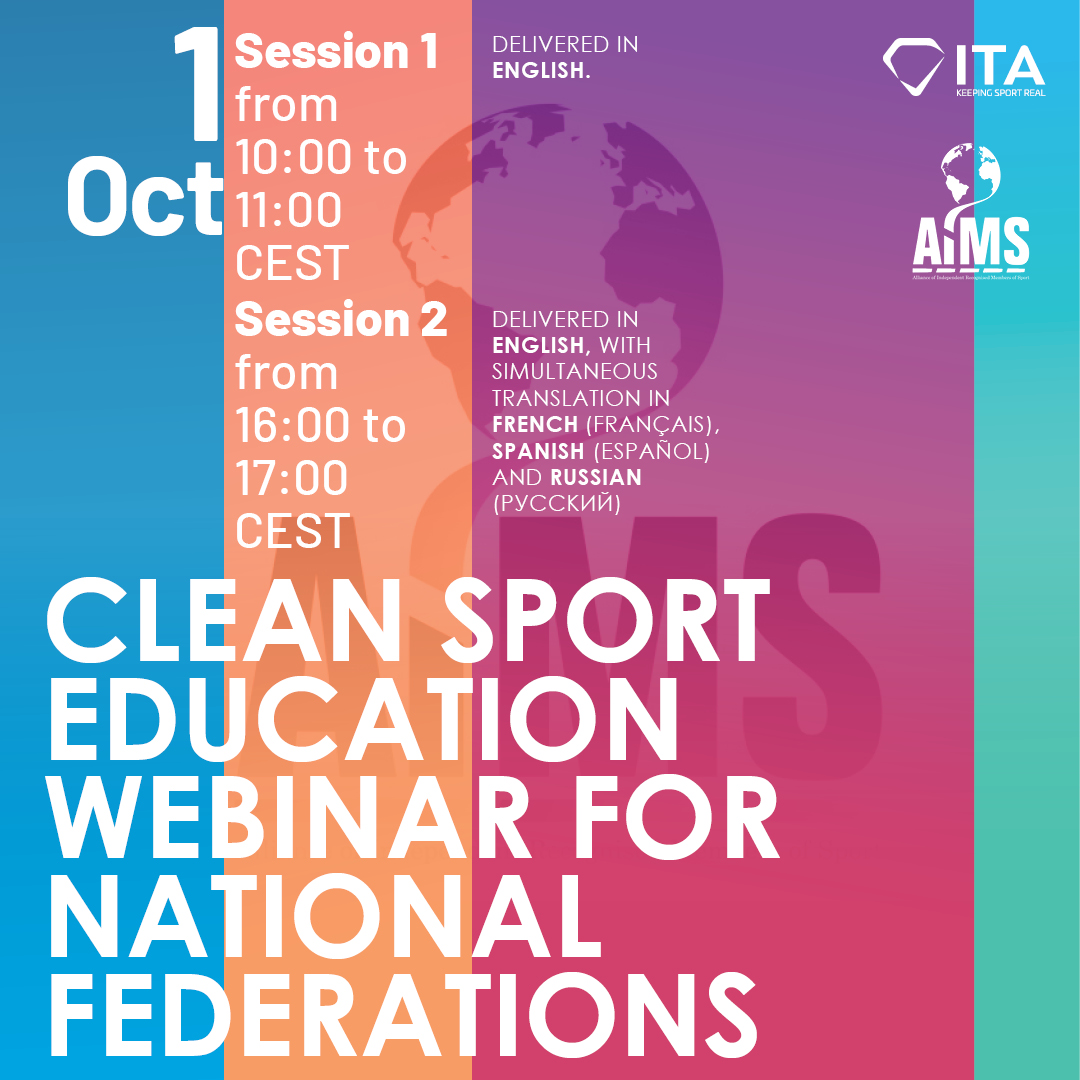
Activities with ITA-AIMS
The FMJD delivers its clean sport education programme together with the
International Testing Agency (ITA), through the
Alliance of Independent Recognised Members of Sport (AIMS).
This section collects the FMJD’s current and future activities with ITA-AIMS. It is updated as new activities are announced.
Current and upcoming activities
Throughout 2026 – ITA Monthly Webinars
In addition to the FMJD-specific activities, the ITA offers monthly webinars on key topics for athletes and Athlete Support
Personnel. Sessions are delivered in English with simultaneous translation in Arabic, French, Russian and Spanish, and with
automated translated captions.
Subscribe to the ITA Newsletter to receive registration information
ITA YouTube channel – recordings of previous sessions
Throughout 2026 – Preparing for the 2027 International Standard for Education
During 2026 the FMJD works closely with the ITA to prepare for the changes introduced by the
2027 International Standard for Education,
which takes effect on 1 January 2027.
Permanent resources
The ITA Athlete Hub – rights and responsibilities, TUE and retirement forms, and a collection of resources with expert-answered FAQs on each key anti-doping topic.
WADA’s Anti-Doping Education and Learning (ADEL) Platform – free e-learning courses in many languages for athletes, coaches, medical and other support personnel.
2026 Prohibited List – in force since 1 January 2026.
List of National Anti-Doping Organisations (NADOs) – under the World Anti-Doping Code (Article 20.3.13) National Federations conduct education in coordination with their applicable NADO.
For any further information, please contact cmo@fmjd.org.
Dr. Renato Capurro – Chair of the FMJD Medical Committee